
Proven Dental IT Strategies Driving Clinic Marketing Success
Introduction
When IT and marketing work together, technology stops being a cost center and starts driving new patient growth. This guide shows how reliable infrastructure, strong security, and smart automation turn your systems into repeatable patient-acquisition and retention channels. We’ll define “dental marketing IT,” explain how infrastructure and privacy affect your online presence, and show how AI, cloud backup, and managed services convert technical stability into greater visibility and patient trust. Many practices treat marketing and IT as separate functions — that creates friction in booking flows and makes results hard to measure. Aligning them smooths the patient journey and strengthens local search performance. You’ll get practical steps across five areas: infrastructure & website performance, cybersecurity for marketing data, AI and automation for engagement, cloud continuity, and managed IT for growth. Along the way we include checklists, comparison notes, and implementation advice to help practice leaders and marketing teams prioritize the technical fixes that most reliably lift visibility and bookings.
How Does Robust IT Infrastructure Enhance Dental Clinic Online Presence?
Think of infrastructure as the plumbing behind your digital front door. Hosting, networking, and site delivery keep your website fast, available, and crawlable — which lowers abandonment and improves the signals search engines use to rank you locally. Faster hosting, a CDN, resilient DNS, and SSL/TLS reduce TTFB and improve Core Web Vitals, which in turn raise conversion rates for online booking. The benefits are concrete: more organic visibility, better click-throughs from your Google Business Profile, and fewer lost leads from outages or slow pages. Treating infrastructure as a marketing lever reframes tasks like caching, mobile optimization, and uptime SLAs as investments in acquisition and reputation. The sections that follow outline specific reliability solutions and the technical SEO steps that strengthen local search and GBP engagement.
Website speed has a direct effect on engagement and retention — users often abandon slow pages, so performance really matters.
Optimizing Dental Website Performance with Web Vitals
Users expect fast, smooth experiences. Research shows that more than half of visitors leave sites that take longer than three seconds to load, so measuring and improving speed is essential for keeping potential patients engaged.
Web performance tooling and the importance of web vitals, MK Dobbala, 2022
What IT Solutions Ensure Fast and Reliable Dental Websites?
A high-performing dental website depends on managed hosting, CDN caching, continuous monitoring, and regular optimization so appointment funnels stay responsive and secure. Managed hosting with a CDN reduces geographic latency and holds up under campaign-driven traffic spikes. Application-layer caching and optimized images help LCP and overall UX. Synthetic and real-user monitoring with alerting lets teams fix issues before they hit conversions; track KPIs such as TTFB, LCP, FID, and uptime against SLA targets. Build mobile-first pages and a streamlined booking flow to cut bounce rates from local searches and increase completed appointments. Implementing these solutions converts uptime and speed into measurable marketing gains like higher booking conversion and stronger Google Business Profile engagement.
Intro to hosting and network options table: different hosting and network setups affect uptime, security, and SEO in distinct ways — the table below helps clinics choose the right approach.
| Hosting / Network Option | Key Attribute | Effect on Site Speed and SEO |
|---|---|---|
| Managed Cloud Hosting | SLA-backed uptime, automatic scaling | Steady TTFB, improved Core Web Vitals, handles traffic spikes |
| CDN + Edge Caching | Distributed caching at the edge | Lower latency for local and mobile users, improves LCP |
| Shared Hosting (Budget) | Limited resources, variable performance | Slower load times and higher risk of SEO issues under load |
| Dedicated / VPS Hosting | Reserved resources, greater control | Predictable performance; good for custom integrations |
In short: managed cloud hosting plus a CDN is the safest choice for sites that drive bookings. Shared hosting may save money upfront but increases the risk of lost leads and lower search visibility.
How Does IT Support Local SEO and Google Business Profile Optimization?
Technical SEO and IT practices directly affect local search by ensuring structured data, fast mobile pages, and consistent contact signals that feed Google Business Profile and local directories. Implement LocalBusiness schema, keep NAP (Name, Address, Phone) consistent across systems, and make sure pages linked from your GBP resolve quickly — these steps improve local relevance. IT can also automate secure review requests while preventing duplicate or corrupted contact records, and technical fixes to mobile UX increase GBP interactions like click-to-call and directions. Regular GBP health checks — tracking post visibility, category accuracy, and service listings — paired with site-level optimizations strengthen your local footprint. Together, these technical steps make it more likely that local searchers become booked appointments.
Local SEO checklist for IT and marketing teams:
- Keep NAP consistent across website schema and directory listings.
- Apply LocalBusiness schema and service-level markup where appropriate.
- Optimize mobile pages and appointment flows to lower bounce and boost GBP interactions.
- Automate review requests securely while protecting PHI and contact integrity.
Use this checklist to improve local ranking signals and lay the groundwork for higher conversion rates from local search. Technical SEO paired with content and reputation work delivers the best results.
Why Is Cybersecurity Critical for Dental Marketing Data Protection?
Cybersecurity for marketing protects patient contacts, booking records, and analytics so outreach stays compliant and trustworthy. Strong security — encryption, access controls, backups, and monitoring — prevents breaches that harm reputation, trigger penalties, and interrupt campaigns. For marketing teams, the upside is clear: preserved patient trust, uninterrupted outreach channels, and less reputational risk. The following sections explain how regulations shape marketing IT and which controls to prioritize for compliance and trust-building.
How Does HIPAA Compliance Influence Dental Marketing IT Practices?
HIPAA and similar Canadian privacy rules determine how clinics handle patient information in marketing by setting requirements for consent, storage, and transmission. In practice, that means classifying fields (PHI vs. non-PHI), using encryption in transit and at rest, and ensuring third-party marketing tools have the right agreements or safeguards. Any automation that uses appointment details or clinical notes requires explicit consent and secure channels, and retention policies should limit exposure. Compliance reduces legal risk and also signals responsibility — clear privacy practices increase patient confidence to share contact details for reminders and promotions.
| Cybersecurity Measure | What It Protects | Marketing Trust / Impact |
|---|---|---|
| Encryption (in-transit/at-rest) | Contact lists, booking records, CRM data | Shows secure handling and lowers breach risk |
| Access Controls & MFA | Admin panels and marketing portals | Limits insider risk and improves governance |
| Regular Backups & Disaster Recovery | Websites, CRM, campaign assets | Maintains outreach continuity and protects reputation |
| Monitoring & Incident Response | Suspicious access and data exfiltration | Faster remediation, reduced public exposure |
The table highlights that encryption and access control are foundational, while backups and monitoring keep campaigns running after incidents.
What Cybersecurity Measures Protect Patient Data and Build Trust?
A layered approach — from simple wins to more advanced controls — protects marketing data and signals trust to patients and regulators. At a minimum: encrypt databases and backups, enforce strong access controls with MFA, and use role-based permissions on marketing tools that handle contact data. Keep systems patched, run endpoint protection, and maintain logging so anomalies are caught early. Have an incident response plan with communication templates to protect reputation. For marketing trust specifically, publish clear privacy notices and use explicit opt-in mechanisms for email and SMS. These practices lower breach risk and help keep patient acquisition steady.
Key cybersecurity checklist:
- Encrypt PHI and sensitive marketing lists both at rest and in transit.
- Require MFA and role-based permissions on CRM and marketing platforms.
- Keep tested backups and a documented incident response plan.
- Publish transparent privacy notices and maintain explicit consent flows.
Following this prioritized checklist builds compliance and credibility — security becomes a differentiator for patient trust.
If you prefer hands-on help, many clinics engage vendors that combine healthcare IT experience with lifecycle services. At DentalTek, we provide cybersecurity solutions tailored for dental practices to secure marketing data while minimizing operational disruption — contact us for a demo or scoped support to see how these controls can be applied without interrupting patient-facing systems.
How Can AI and Automation Transform Dental Patient Engagement Technology?
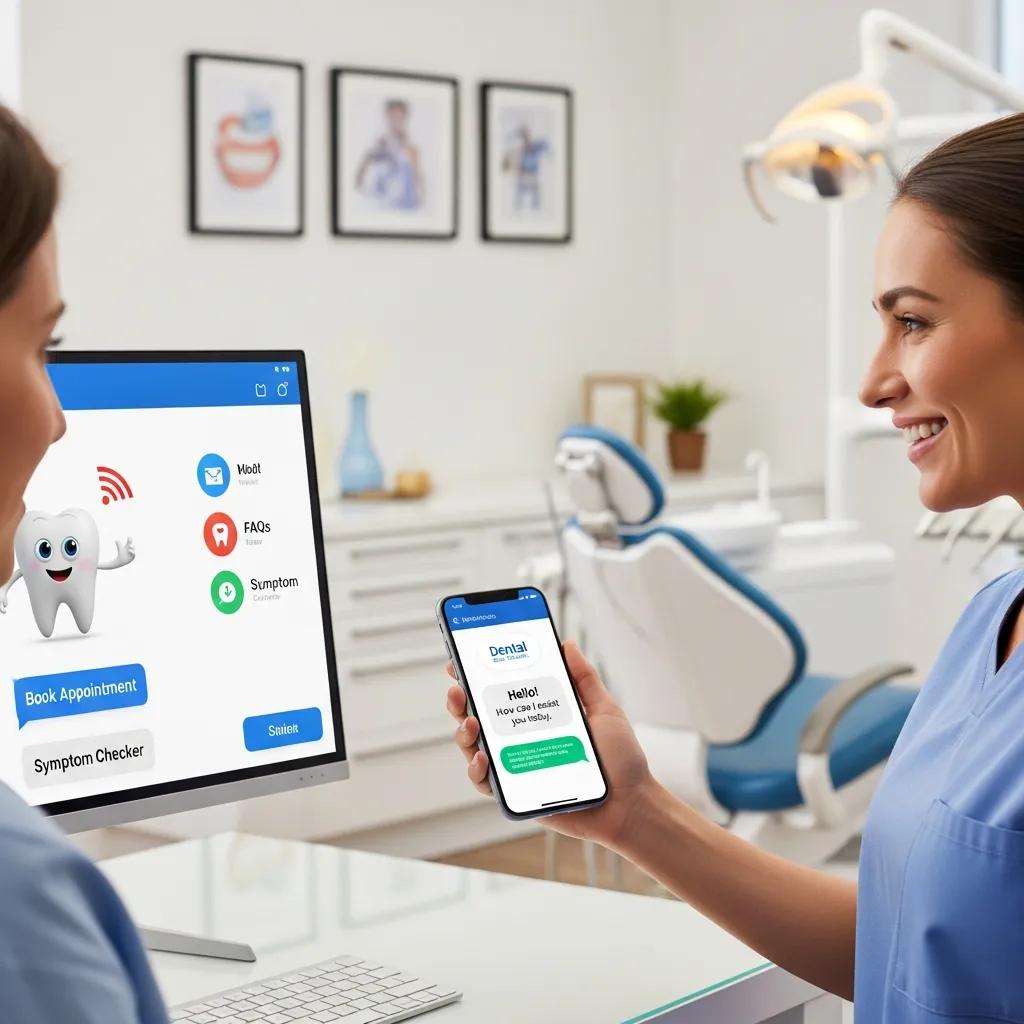
AI and automation create fast, personalized touchpoints that capture leads, reduce administrative load, and raise booking conversion. The value comes from routing and automation that qualify intent, schedule efficiently, and enable targeted outreach. Chatbots and automated workflows handle first contact 24/7, answer common questions, and integrate with schedulers to close the booking loop without manual handoffs. Predictive analytics lets you segment patients for timely reminders and recalls, improving retention and lifetime value. The next sections describe chatbot benefits and appointment reminder automation that support reputation and operational efficiency.
What Are the Benefits of AI Chatbots for Dental Patient Communication?
AI chatbots act as after-hours intake agents that answer FAQs, triage requests, and capture booking intent — reducing phone load and converting more search or GBP clicks into appointments. When integrated with scheduling or practice management systems, chatbots can show available slots, hold reservations, and trigger secure reminder flows, which often leads to more same-week bookings and fewer abandoned leads. Conversation data — preferred contact method, treatment interest, urgency — enables more relevant follow-up and better retargeting. Shifting early lead qualification to automation frees front-desk teams for higher-value patient care.
AI chatbot practical checklist:
- Integrate the chatbot with scheduling and CRM for smooth handoffs.
- Train intents for common appointment types and insurance questions.
- Avoid capturing PHI in open chat unless you have secure consent and storage.
- Monitor flows for escalation triggers and hand over to staff when needed.
These steps help implement chatbots that increase capture rates while protecting data and the patient experience.
How Do Automated Appointment Reminders Improve Patient Outreach?
Automated reminders — especially two-way SMS — get higher read and response rates than email, cut no-shows, and improve rebooking. Timely, channel-preferred prompts let patients confirm, reschedule, or reply quickly. Sync reminders with your practice management system so schedules stay accurate and confirmation data feeds marketing metrics for better forecasting. A common cadence is initial confirmation, a 72-hour reminder, and a 24-hour SMS prompt that enables two-way rescheduling — a pattern shown to reduce no-shows. Post-visit, automated review prompts encourage satisfied patients to leave feedback while the experience is fresh.
Automated reminders implementation checklist:
- Use two-way SMS for highest engagement and easy rescheduling.
- Keep reminder status synced with appointment and CRM records in real time.
- Use concise, compliant messaging that avoids revealing PHI.
- Add post-visit review prompts to capture reputation signals while the visit is recent.
Automated reminders streamline operations and strengthen retention and reputation, which supports better local search performance and higher conversion.
What Role Do Cloud Solutions Play in Scalable Dental Marketing Strategies?
Cloud solutions — hosting, SaaS integrations, and cloud backup — give predictable performance, scalability, and integration flexibility so multi-channel marketing and analytics run smoothly. By moving critical systems off-prem, clinics avoid single points of failure and keep tools available during campaigns. Cloud backup enables fast recovery of websites, CRM data, and creative libraries so appointment flows stay live after incidents. SaaS integrations centralize analytics and automate outreach, while cloud environments speed deployment of new marketing features. The next sections cover backup strategies and the main benefits of cloud-based IT for clinics.
How Does Cloud Backup Secure Dental Marketing Assets?
Cloud backup protects websites, CRM exports, and marketing assets with defined RTO (recovery time objective) and RPO (recovery point objective) so outreach can be restored quickly. The mechanism is automated, versioned offsite backups that are tested for recoverability. Recommended cadence depends on criticality: daily backups for CRM and booking exports, hourly or continuous replication for transactional booking data, and snapshots for website and content assets. Have clear recovery scenarios — spin up a standby site, restore CRM to a clean point, and re-sync appointment data — so campaigns and booking flows remain live during an incident. That continuity reduces lost leads and preserves campaign delivery and reputation.
| Backup Approach | Typical Restoration Time | Cost Consideration | Marketing Continuity |
|---|---|---|---|
| Cloud Backup with Versioning | Minutes to hours | Predictable subscription | High; fast site and CRM restores |
| On-Premise Backup | Hours to days | Capital + maintenance | Medium; hardware failure risk |
| Hybrid (Cloud + Local) | Minutes to hours | Moderate | Very high; added redundancy |
| Manual Export Only | Days | Low direct cost, high manual effort | Low; slow recovery, campaign disruption |
What Are the Advantages of Cloud-Based IT for Dental Clinics?
Cloud-based IT speeds deployment of marketing tools, offers predictable subscription pricing, and gives staff secure remote access to manage campaigns and patient messages. Scalability means your clinic can handle traffic surges from promotions or location launches without performance drops. Centralized management simplifies updates and security patches across integrated systems. Cloud SaaS also unifies analytics — connecting website behavior, GBP activity, and email/SMS performance into one view for smarter targeting. Altogether, cloud solutions reduce technical friction and shorten time-to-value for marketing initiatives.
Cloud adoption checklist for marketing readiness:
- Back up critical marketing assets to the cloud and test recovery procedures.
- Pick SaaS tools with secure integrations to your practice management system.
- Plan capacity for campaign peaks to avoid slowdowns.
- Centralize analytics to measure cross-channel attribution and ROI.
Cloud adoption helps clinics scale outreach confidently and keep campaigns running when it matters most.
How Do Managed IT Services Support Dental Practice Growth and Marketing Success?
Managed IT services keep the systems that power marketing — websites, backups, networks, and integrations — monitored, patched, and optimized so your team focuses on patient care and growth instead of firefighting. Continuous management (24/7 monitoring, timely patching, and capacity planning) catches issues early, reduces security-related downtime, and prepares infrastructure for campaign-driven traffic. The result is better uptime, protected marketing data, and faster campaign iteration because the technology layer is stable. The sections below outline managed offerings and how ongoing support links to marketing ROI.
What Managed IT Services Optimize Dental Clinic Marketing Operations?
Services that directly support marketing include network monitoring, patch management, automated backups, and application performance management. Together these reduce outages and keep booking flows running during promotions. Monitoring plus fast remediation prevents campaign-driven traffic from causing failures, while patching lowers the risk of incidents that could take systems offline. Capacity planning accommodates spikes from ads or seasonal demand, and managed backups protect campaign assets and CRM data for quick restoration. Mapping these services to marketing outcomes — uptime to conversions, backups to reputation safety — makes the ROI clear.
Managed services mapped to marketing outcomes:
- 24/7 monitoring → faster remediation → fewer lost leads during campaigns.
- Patch & vulnerability management → lower breach risk → preserved reputation.
- Backup & DR planning → quicker recovery → uninterrupted outreach.
Aligning managed IT to marketing KPIs gives clinics a dependable technology foundation for growth.
How Does Ongoing IT Support Enhance Marketing ROI for Dental Practices?
Ongoing IT support improves marketing ROI by removing technical barriers that create drop-offs in the patient journey and by speeding up deployment of new campaigns and integrations. Trackable KPIs include lower unplanned downtime, improved site speed metrics, higher booking conversion rates, and faster time-to-deploy for campaign updates. With predictable performance, marketing teams can confidently invest in paid channels and conversion tests. Reduced admin overhead also frees staff to focus on outreach and in-office experience, strengthening retention and referrals.
Performance measurement recommendations:
- Track uptime percentage and correlate it with booking conversion.
- Include Core Web Vitals in campaign pre-launch checks.
- Measure no-show and rebook rates before and after reminders and automation.
- Attribute local search gains to technical SEO and GBP health metrics.
These measurements make the value of managed IT tangible and show how technical reliability drives marketing results.
If you want an audit-led, lifecycle approach — audit, takeover, upgrade, and ongoing maintenance — DentalTek offers a managed-services lifecycle tailored to dental workflows. Contact us for a demo or to explore an audit-driven roadmap that ties IT investment to marketing goals.
DentalTek specializes in IT for dental clinics: managed services, network support, cybersecurity, cloud backup, audits, takeovers, upgrades, and maintenance. Our focus is seamless technology that empowers patient care while keeping patient data and marketing operations secure. Reach out for a demo or support.
Clinics that integrate solid IT, strong security, AI-driven engagement, cloud continuity, and managed services turn technology into a predictable growth engine. Treat IT as a strategic partner to marketing to reduce lost leads, improve local search results, and build patient trust through secure, consistent interactions. If you prefer guided implementation, DentalTek provides lifecycle services and cybersecurity designed for dental workflows — contact us for a demo or to review an audit-driven plan aligned to your marketing objectives.
Frequently Asked Questions
What are the key benefits of integrating IT and marketing in dental practices?
Bringing IT and marketing together reduces friction in the patient journey and improves outcomes. You’ll see faster, more reliable booking flows, better website performance, and stronger data security. This alignment enables personalized outreach, automated communications, and clearer measurement of what’s working — all of which help attract and retain patients.
How can dental clinics measure the effectiveness of their IT marketing strategies?
Measure impact with clear KPIs: website traffic, booking conversion, engagement rates, and local search metrics. Use tools like Google Analytics and your practice management reports to track behavior and conversions. Regular audits of local SEO and Google Business Profile activity also reveal whether IT changes are improving visibility and bookings.
What role does patient data play in dental marketing strategies?
Patient data enables targeted, relevant communication — appointment reminders, recall campaigns, and tailored offers. That said, handling data securely and with consent is essential. When managed correctly, patient data boosts engagement and loyalty while protecting trust and compliance.
How can dental practices ensure compliance with data protection regulations?
Compliance starts with basic controls: encryption, access controls, regular audits, and staff training. Choose marketing tools that support HIPAA or equivalent privacy safeguards and maintain clear consent and retention policies. Regularly review procedures and vendor agreements to stay aligned with regulations.
What are the advantages of using AI in dental marketing?
AI improves responsiveness and personalization. Chatbots and automation capture leads 24/7, help schedule appointments, and surface actionable insights for targeted outreach. Predictive analytics can identify patients likely to rebook or need recall — enabling proactive campaigns that boost retention.
How can cloud solutions improve dental marketing operations?
The cloud gives predictable performance, scalable capacity, and easier integrations. Cloud backups protect critical assets and speed recovery after incidents. Centralized cloud analytics make it simpler to measure cross-channel performance and optimize campaigns in real time.
What should dental practices consider when choosing managed IT services?
Look for providers with dental or healthcare experience, strong security practices, and clear SLAs. Evaluate services for cybersecurity, backup and recovery, network monitoring, and application performance. Also consider how the provider supports compliance, offers ongoing maintenance, and structures pricing for long-term partnership.
Conclusion
When IT and marketing are aligned, clinics gain a reliable platform for growth: faster sites, safer data, smarter outreach, and predictable recovery. Leveraging AI, cloud services, and managed IT turns everyday systems into tools that drive bookings and patient trust. If you want help turning that strategy into action, DentalTek can partner with you — schedule a demo to see how an audit-driven plan can align IT investments to your marketing goals.